13 May 2013

Posted by Anna Notaras | File under : , , , , ,
by N. C. Wyeth
Royalty has always been impressive, and not all due to the fairy-tales hailing from medieval times. It tends to go beyond the opulence of royal families and the attractive high social status. Even the power factor itself doesn't fully justify the fascination, as we can see there is more to it. Presidents, statesmen and politicians today certainly do not have the same aura as a king, nor could ever inspire the same sympathy. 

People in need of true leaders
Even those who would never admit it still need them. Not to be controlled by them, but to be inspired. A loyal, caring but fierce, righteous and firm leader easily becomes a role model. For this reason, people have usually loved kings - those of older times mostly - and still do. Have a look at the quest for Richard III's grave. Many had even donated money to support the archeological dig. The people were there, for a king dead long ago, a king who was vilified. As the findings were made public in February 2013, enthusiasts from all over the world knew a renewed interest in ancient British royalty. It was fascinating. Moreover, it was not about him being a presumed murderer (there is nothing unusual in that, considering his era and status), not about the discovery itself even, because it could simply be reduced to a skeleton found underneath a parking place. It was about having found someone important from those times, someone who ruled and fought.

Warrior kings
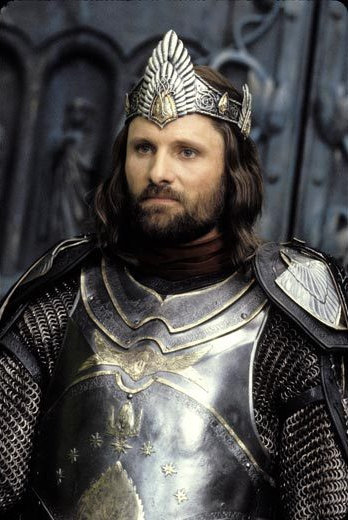
King Aragorn (Viggo Mortensen)
Unfortunately, the days of true monarchs are gone. There is no way to compare an 'office ruler' to a sovereign who would take his horse and sword, charge the army and go into battle. Those sovereigns of the past were ready to die - and for a noble cause. To this aspect let us add the values they used to embody and profess. Kings, unlike state leaders nowadays, based their rule on certain ethics. Unless we are talking about tyrants, they were quite charming, captivating, awe-inspiring, courageous.

What do we have left today?
The history passionates may not feel completely deserted, because they can easily take refuge into history books and contemplate what once was. Nevertheless, this could hardly be a universal solution to our hunger for kingly values. Luckily, for the rest of us there are the books - the fiction ones especially. Also, there are the movies. It seems that, wherever we look, the best stories are those involving royalty and perhaps some war, too. 

Kings in movies and the people's reaction nowadays
Richard Armitage as Thorin Oakenshield in The Hobbit
Prince/crownless king Thorin Oakenshield (Richard Armitage)
Without a doubt, they absolutely love them, plain to see. Fantasy writer J.R.R. Tolkien and now director Peter Jackson have been milking this frantically. They created fascinating monarch figures, addictive even. (The Game of Thrones is not far from that, either).

Pop culture has been invaded by long-haired, more or less bearded, armed kings and princes - characters the world once thought to be just relics, incompatible with our times. For the disbelievers, there is always available evidence online of the legacy of Aragorn Elessar, to give the most prominent example. More recently, another warrior king claimed the spotlight. As of December 2012, when the first film of The Hobbit trilogy got on screen, Thorin Oakenshield quickly gathered an army of thousands of followers. The character, although invested with traits that weren't supposed to attract sympathy, surpassed all expectations and became a detached favorite of the crowds. Handsome, incredibly daring and courageous, fighting for honor, loyal, caring for his kin, proud, determined, rugged, aware, this noble hero enraptured viewers in a way rarely seen before.

Kings with all their might, even with their burdens, turmoil and failures, embody everything that many of us find fascinating. Some may have forgotten, some may be denying it, but there is a longing for all of their kingly traits, for their rare qualities. Those like me are fully confessing it: we feel that the world has never been in a greater need of righteous kings than it is now. 

10 May 2013

Posted by Anna Notaras | File under : ,

Building yourself an undeserved brand.
Unless you are a professional of some kind, there is no reason to get yourself a fancy title, a logo, a watermark with your name and so on. Also, do not present yourself writing in third person. Do not mention it is your "official Facebook profile" unless you really are a celebrity.Let the fame come first, and then tune your profile to match it if so you wish. Don't brand yourself just for the sake of it.

Arguing over tastes and opinions.
"Welcome to the Internet, where opinions are facts", a good observer said once.Sarcasm, I hope you detected it. Sadly, most users are acting as if all opinions - their especially - are undeniable facts. Getting all inflamed because someone praises a book you didn't like, is a fan of an actor you hate or has different beliefs than you is a sign of severe immaturity. Unless they try to push their choices on you, there is no reason to get alarmed, really. You wouldn't want to be jumped at for choices that aren't harmful.

Starting an argument with someone, then unfriending/blocking them yourself.
Nothing spells 'psycho' better than behaving like this. If you provoke someone, overly criticise, insult, condemn or troll in an open manner for what they have posted, and then you are the one to act hurt and upset, you shouldn't be on Facebook at all. It's up to the other person whether you stay in the list or not.

Over-bragging.
Alright, Facebook is indeed a place where everyone want to be seen as better than they really are, where they show to their ex their so-much-better actual partner, where they post holiday plans and pictures, show how many parties they attend and so on. Therefore, bragging is normal here, but when you overdo it you sent a terrible message out there. No one will be impressed that you ate 3 types of expensive French cheese for dinner, that you just went shopping where none in your friends list can afford, or that you look astonishing in bikini. When too much is too much, you simply pass as desperate to prove your worth. The breaking news is that such despair will never work in your favor, to state the obvious.

Being hostile to nerds.
It's OK to have a passion and it's OK to not take Facebook so seriously. Let those nerds be, let them post and share about The Lord of the Rings, Sherlock or Star Trek - at least they have a passion and they're having fun. If it's too much for you, filter out their updates and remember that we are all here to post whatever we like. Maybe your friends are also sick of your objectifying pics of naked women. There is really no reason to turn hostile or to ridicule those people. After all, you may be that annoying user who plays FarmVille or other extremely intelligent form of entertaining, pestering others with game requests.

Being the rebel.
Maybe some find it cool in school, but when you keep on being the rebel just for the sake of it and you overdo it, there is nothing good to believe about you. It spells no intelligence whatsoever to post only 'scandalous' words or photos, to talk dirty, to mention all the time how 'naughty' you are, to brag about how you don't conform to social or moral norms. It is boring and ridiculous.

Getting inflamed at grammar Nazis.
Grammar Nazis spotted a mistake and they want people to respect their language and to write in an acceptable manner. Point is, you wrote something wrong. Deal with it. It makes no sense to start a flame war because someone corrected you.

Too many post.
Some users out there make at least 20 posts a day, which is beyond more than we can take. Even though your posts are cute, interesting or you really want to share them so badly because they are pure treasures, temper yourself and understand that everyone eventually gets tired of having their newsfeed invaded by a single user. This forces us to unsubscribe and thus your really important updates may be seen by no eyes in the end.

Being there all the time.
Whenever I go to my account, I see the exact same people posting, liking or commenting right at the time. No matter the time of the day.When I check friend's updates, the same people have already liked or commented. Everything. They leave their prints on everything there is. Stop it and get a life. If you think that being there all the time is going to improve your life, stop now. You're not social, you're creepy.

And ultimately... liking your own posts.
It is beyond obvious to anyone that the update/news/photo/video/status you posted is relevant, important, funny or likeable to you. Therefore, what is the point of giving it a 'like' yourself?...

8 May 2013

Posted by Anna Notaras |
- Part of the analytical journey "Film Thorin vs. Book Thorin" -
"At the University, we used to debate whether a literary work can be greater in the end than its author has intended. An author may unconsciously invest his work with underlying meanings and traits. While he is unaware, others may catch on those."
Richard Armitage as Thorin Oakenshield in The Hobbit
The human mind works with archetypes, and this is what we usually deal with in Literature and Film. Therefore I would appreciate it if certain types of readers don't get inflamed and don't consider this as religious propaganda, indoctrination and so on, because it is a simple talk of archetypes, their meanings and how we have these impregnating our art.
Undeniably, Tolkien was a devout Christian of Catholic denomination.
No matter what your beliefs are, it is impossible to write something that is not in tune with them, especially when it's such a vast work of art. Considering this, one is often tempted to find the places where the author's beliefs are getting through in a more obvious way - be it planned or not. In the light of such fact, we can venture to explore Tolkien's books and analyze their nature. With Thorin Oakenshield, things have taken an interesting turn, especially with the cinematic installment.

A New Archetype: Thorin as a "Warrior Christ"

The term of "warrior Christ" came to me as I was counting all the striking similarities, as well as the obvious contrasts. Tolkien couldn't have had the intention of making such a portrayal, because the ending and the moral of the story stand in opposition to this idea. But to me, the King Under the Mountain is noble, loving, kind, loyal and determined, he has a certain purity of the soul, in spite of his anger, hurt and bitter destiny. I had to find a term to describe his uniqueness. Below is a list of the coincidences, followed by insights of how the character would create a new and captivating archetype.

    The Coincidences:
  • ascetic, not married
  • has an exceptional following (not only in the company he gathers for the quest, but also outside the work of art itself, in the fandom)
  • been a simple worker for many years of his life (blacksmith)
  • capable of immense love - not only for his kin, but even for the hobbit he much despises.
  • noble origin
  • has 12 immediate followers
  • these followers are not of the brightest (also the disciples were seen as imperfect many times, but it was the "willing heart" that got them there)
  • it's himself to say - not Balin - "for when I called, they answered" (Balin is the disheartened one, but Thorin has the hope, he sees the good in them).
  • set to reclaim his father's lost kingdom
  • dies because of his mission, but is sure of the afterlife and looks forward to going to the halls of his ancestors.

As a close observer of The Hobbit phenomenon, what I was amazed by was the incredible following that Thorin would get with the first film. Although his position was meant to have common points with that of an antagonist (which is anyway a gross exaggeration to me), he got way ahead of Bilbo - he practically stole the show. He would inspire genuine appreciation and love, and lead fans to the point of fanaticism. If Thorin were a real leader existing on our planet, there would have been great unrest within the society. I can safely assume that his followers would be quickly seen as a fierce, exhilarated and uncompromising sect that would have in sight nothing else but their leader and his goal. My claims may appear as exaggerations, but the time spent at the core of the fandom and the endless conversations I had with various fans have shown me so. Thorin's charisma as a leader and a hero are undeniable. Indeed it would be very interesting, to say the least, to have a real, living Thorin.


Tolkien hasn't conceived Thorin as a christic figure, by no means. But then why....

Well, he obviously hasn't, but then shall we just ditch all those coincidences? I believe the one we should look at from now on is Peter Jackson. He was the one to invest so many of such elements, that is impossible not to think of it. A warrior Christ I'd call him, why not? Humans work with archetypes, and this is what we usually deal with in Literature and Film. Therefore I would appreciate it if certain types of readers don't get inflamed and consider this as religious propaganda, indoctrination and so on, because it is a simple talk of archetypes, their meanings and how we have these impregnating our art.

Allegory? I wouldn't go that way. There is something however, and this exquisite portrayal made me call Thorin Oakenshield the warrior version of Jesus. Perhaps he isn't supposed to convey more than Tolkien initially intended. Therefore he is just that: a unique kind of character, which everyone is free to interpret as desired. This is my interpretation, one still burdened by many question marks.

A book can be more than what its author has intended...

As seen in the film, Jackson & Co. have invested in Thorin much more. Thorin has lines that don't appear in the book (in the Bag End scenes especially), but which deepen his character and are very relevant. Most of the coincidences posted above are rather emphasized in the film. Could Peter Jackson have wanted to take this character to a different level? Could he have seen certain potential in him that Tolkien hadn't seen? We have a greater King of the Dwarves thanks to him. At the University, we used to debate whether a literary work can be greater in the end than its author has intended. An author may unconsciously invest his work with underlying meanings and traits. While he is unaware, others may catch on those. It is what I was trained to recognize when dealing with a work of art. I am sure this can be applied to many cases.

Possible Reasons

I am purely speculating here, but Sir Peter Jackson could have invested the King with these traits for their appeal to the masses. The great majority of the viewers would pick on these clues (subconsciously or not) because they are familiar to them. It also makes the story more touching. There will be drama, beware.

11 February 2013

Posted by Anna Notaras | File under : , , ,

On February 5th, The Richard III Society officially unveiled the facial reconstruction of the English king, after having assured the skeleton found in Leicester was his.

The monarch died aged 32 in the Battle of Bosworth, and no contemporary portrait had survived. The existing postmortem ones invested him with less than flattering features, now to be proven wrong.

Photo: Dan Kitwood/Getty Images
It has certainly been a great adventure, this chase for King Richard III. As the skeleton found under a parking lot in Leicester was finally confirmed to be the king's, through DNA tests and matching with the descendants. To the identification process also contributed the battle wounds evidence.


The facial reconstruction was in no way aided by any of the portraits, except for when determining the colors and the fashion. The result revealed was stunning: not only that we can state that Richard III was a handsome monarch but, although features like his nose and prominent chin were existing in portrayals as well, the reality put his enemies to shame. History is written by the victors, as we know. Once again, it is being confirmed to us. In Richard III's case, those who came to rule after his reign did their best to invest him with flaws and create a mean appearance. Centuries after, their scheming turned against them, finally. Richard looks noble, kind, serene and handsome. It may seem like an unscientific approach to make statements based on physical features, but the leader of the project, Philippa Langley, didn't censor that herself. It is a natural reaction to do so, perhaps stemming from a long experience of seeing physical features as matching the ones of the psyche.

By all means, the most touching part about his appears to be this: that thousands, or rather millions of people get to look Richard III in the eye after so many centuries, that we can all see his face right now, as it was back then. And what do we see? A human, not a monster. It is interesting how, among the first reporters and scientists, many got to discuss his features, in an attempt to draw the man's character from his physical appearance. It seems that we, humans, cannot resist this. It is like an irresistible temptation to start observing one's facial features and make a whole profile based on that. 

Killed on August 22nd, 1485, Richard III could never be fully condemned for any atrocity, not even with the modern investigation techniques. Moreover, he did not have a wretched arm or a hunch back, since he only developed scoliosis, which only causes the spine to form a sideways curvature and uneven shoulders. He made donations to the poor, and he wanted the throne like any other heir would.

To the others, the Richard III Society had been just a bunch of fanatics lost in silly medieval dreams and defending these - with fanaticism, of course.These detractors might have never heard of Schliemann and his Troy...


11 May 2012

Posted by Anna Notaras | File under : , , ,
"Esoteric psychology in the first place is directed toward changing a person’s inner world, changing our way of thinking, of seeing ourselves and the surrounding world.
Esoteric psychology does not deal with the effects, but with the causes of a given problem, and in this way it helps us getting rid of it forever.
The term “esoteric” means inner knowledge or, in other words, knowledge of what is hidden, unseen by our eyes; knowledge concerning the conditions of our energetic body, knowledge of our soul..... In a nutshell, it refers to any cryptic knowledge withheld from the masses.
Esoteric psychology is based first of all on the knowledge of fundamental Cosmic Laws and it helps us understanding our purpose in life, formulate our life goals correctly and manifest them in practice." (http://universynergyarts.co.uk/esoteric-psychology.html)


The hermetic book The Kybalion states the Law of Polarity among the essential Laws governing the Universe.

REBT is a therapy often encountered nowadays, that appears as dehumanizing, because of reasons explained in another post. It mostly tells people that if something causes them unhappiness, they'd better change the belief that's related to it. (First, I'm not sure if it really deserved the name of therapy or cure, because a lot of people can not relate to it and never get to follow such principles, nor truly experience any kind of healing). It is a strange mix of not blaming others, feeling guilty and at the same time not blaming yourself and not following any logic whatsoever for oneself. This, let's call it, theory, aims to take away the concepts of bad, wrong, sad, unfair, frustrating. While the reasoning may not seem too bad, what it does in the end is to destroy polarities. The funny thing is, no one will cease to feel and live the polarities - only avoid to talk about those. It aims to place humans beyond our oh-so-used dual system (good-bad, right-wrong, nice-unpleasant, hot-cold, light-dark, much-little etc.).

However...

To be above polarities, one must integrate them both. E.g. one has to know the concepts of hot and cold and the degrees in between, the comparison process and so on. Only then he may be able to rise above. Naming and distinguishing between hot and cold asks for a judgment(as mere observation, not of moral kind, obviously).

REBT suppresses one polarity. E.g. One may feel that a friendship brings good things to life. But when a friendship goes sour or fails somehow, the "feeling bad" should be definitely canceled, because it's only in our mind - it's only caused by a belief that we should get rid of, to avoid the suffering and discomfort. Therefore, the bad part of the good-bad polarity is suppressed.

Once a half is canceled, the other one can't exist!
So how can the patient define what is 'good' and what something good is supposed to be, without any reference point inside? If we can no longer feel or define what cold is, how can we use the hot/warm concept? It becomes useless. The other half is emptied of its meaning. With an empty belief/image that something can be hot, one can no longer perceive anything that would be so. They say it just IS. Well, survival would have never been possible - nor communication - without comparisons and degrees.


Psychologists, those of recent times especially... "They quite frankly assert, 'this is the way it is'. And since all people are equally ignorant, nobody dares to object. Very little of what they call rational is rational. The scientific reason of our times is still part of emotionality.
It would be a good thing if the academic spirit were saturated with the understanding that you should not make statements on things of which you know nothing. Even in the learned, more than 90 per cent of what they believe they know (ascertained facts excepted) is sheer fictionalism
." (http://www.laurency.com/L2e/KL2_10.pdf)

Back to our main idea, while still in this body and on this planet, you are a prisoner of polarities. If it is as you wish - that everything is good, how could you actually be able to reject what you don't want? Yet, instinctively, you still stumble upon loads of things, ideas, situations which you reject, resent, feel bad about. You FEEL it. This is exactly why REBT and modern perverted spirituality don't work. They only try to push horse glasses on you. The outer world stays the same, and you realize it once it throws a wet rug in your face. It cannot be avoided endlessly.


Tasting the forbidden apple tree means gaining knowledge and awareness of the polarities - Good and Evil to start with.  Mankind is entrapped now into this type of world, by its own choice. Polarities and what they hold in between their extremes represent an essential of the human thinking. Each choice that is made, no matter how simple, is the result of a judgment like, "It's good to do this instead of that or that, or it's simply better." When you choose a tea flavor/ type from a menu, you base it on this reasoning: "This one tastes better than all the rest. This one is useful to me right now. This one is new and tempting, it is better to try something new now." Any of these supports the one and simple reality: you can't escape the way we all think and act.


Posted by Anna Notaras | File under :
There are two basic forms of prelest or spiritual deception. The first and more spectacular form occurs when a person strives for a high spiritual state or spiritual visions without having been purified of passions and relying on his own judgment. To such a one the devil grants great "visions."
Seraphim Rose
*prelest -
To enter spiritual work without adequate preparation is the sure step to failure. Most people, as soon as they get some spiritual ideas, they become so confident and proud of their own discoveries, that they take these to be something much more than just the tip of the iceberg (which usually is). As soon as they get familiar to certain deep-sounding concepts, they act as if they'd spent good years in India or Tibet and even boast about having found "the way". 

Even for the disbelievers, there is a line that should hold some meaning: "The devil will come as an angel of light". It is easy to mistake a hypnotic state with astral experiences,  a hormonal change with a change of consciousness, an unexpected light with the appearance of God or a guide, a clear voice within with the voice of the higher self and so on. In fact, ANYTHING can be mistaken for ANYTHING in this kind of work.
Since a lot of people around indulge only in a material life and laugh at any hint to spirituality, it is easy for the 'awakened' one to see himself as special. In such conditions, he will not ask too much of himself. A little meditation before sleep, a few mantras or prayers, a bit of reading on some websites... and there he is - ascension is easy! (Strange fact that none of these amazing spiritual individuals haven't yet left this dimension of existence. Oh, wait. They're waiting for that 2012 special energy wave to come over.) Just like that type of people who go to church on Sunday just because, then leave and go on with the same vices, considering that going to church is already quite enough for their so-called spiritual goal. 

While some masters lure their students by telling them to have complete trust in whatever comes their way when taking the path, it is actually advised not to. I rather say DOUBT as much as you can, doubt all confusing ideas that come your way. Being sure of something when it's too soon has never been beneficial spiritually. It means rush, ego, vain pride. The best students are those who start with the premise that one doesn't know enough. In fact, one knows so little...Besides, remember:
You can't even create the things nature creates. Man only learns to manipulate. Man doesn't give life, he merely puts 2 existent cells in contact. Only and only that.


"We are all in deception. The knowledge of this is the greatest preventative against deception. It is the greatest deception to acknowledge oneself to be free of deception."
Bishop Ignatius

"It is not a little labor to attain the truth precisely and to make oneself pure of everything that opposes grace; because it is usual for the devil to show his deception, especially to beginners, in the form of truth, giving a spiritual appearance to what is evil."
St. Gregory the Sinaite

The various forms of occultism have a rather contrary advice. The initiate is told to take for granted everything that happens. How can one trust randomness, the pure arbitrary in an ocean of subjectivity and uncertainty, which is guaranteed by our very imperfect nature, by our very ever changing feelings and thoughts, by these things that simply lead to illusion? How can one be taught to trust exactly that? This is where most methods go wrong, without anyone noticing.

There comes the split inside. Psychologically, the individual is still what he thinks he is (still belonging to the spirituality he started with), but spiritually, he has begun a distinct experience, as long as his mind cannot keep track of the nature of each idea involved. The subject will still claim he belongs to the X group or tradition, but in fact, due to his subjectivity and unseen deceit, has become like a heretic to it.

"Self-confidence and boldness are usually noticeable in people who are in self-deception, supposing that they are holy or are spiritually progressing." "An extraordinary pomposity appears in those afflicted with this deception: they are as it were intoxicated with themselves, by their state of self-deception, seeing in it a state of grace. They are steeped in, overflowing with high-mindedness and pride, while appearing humble to many who judge by appearances without being able to judge by fruits."
Bishop Ignatius


14 January 2012

Posted by Anna Notaras | File under :
You have argued with them, build resentment, ran to them and ran from them, get puzzled by them, turned silent to them, accused, denied, let go of them. All has been there. But have you ever taken the time to really think about what truly makes the woman nature? What makes them be so different, what secret language of the heart of logic they keep inside? Why do you sometimes feel you can't reconcile with them?

Think about the trees. An often encountered spiritual approach distinguishes trees invested with masculine energy and trees built on the feminine one. The first ones, like the oak tree, look fabulously strong outside, with masculine composure, rooted well in the soil. However, a strong wind can take their might away by mercilessly breaking off the branches or the trunk itself. Such trees are rooted off when there's too much to bear. On the other side, 'feminine' species like the pines, birches and willows, look slender and fragile - ridiculously fragile to withstand any caprice of nature. When the winds gets rough, their torment is great, looking as helpless as a leaf. Yet, after the rough weather has passed, they are standing and perfectly surviving. They bend but don't break.
This is the miracle of feminity. A woman can go through the worst of pain, anger or humiliation, yet she will find again the force to carry on and to do something good. Often, she will be the one to comfort you after a fight. She will usually do more for getting back together, although you may see her bending under the winds and almost falling to pieces.

Women are made to nurture and comfort, that's why they still cater to you even when they have blamed you of harm (because they know you lack something inside). Women seek to understand and adjust, that's why they ask you Why.  Women want you to become your best, that's why they 'criticize' and reproach you more as they get closer.


Here is one of the most beautiful and true things ever said about women:

They should be treated with respect, love, and cared for. Women are indeed made to be the most sensitive ones, and without this sensitivity, men will never change to be the best they can be. Do not insult a woman's sensitivity, because this is the only weapon they got to make the whole relationship work. They won’t be able to face their partner without this, or tell them the truth.
(from the blog of relationship coach Cucan Premo)

When a woman becomes silent, turns her back on you or bursts into critique, it may be the best thing that can happen to you. You don't have to admit her being right, nor to lower your head or to change on the spot. Listen to what she is actually saying. While you are ready to leave at her first flagrant mistake, she will be there through countless mistakes of yours, because she knows there is much good to hang on to.

As the song goes, I’d rather have bad time with you than good times with someone else.” 
When this is the case, you are getting the most wonderful and genuine love declaration possible.
This is not about the women who appear as loving today and gone tomorrow, not about those who hide their sorrows and discontent just to make things look perfect on the surface, and not about those who give into your every desire to be the chosen ones.

26 December 2011

Posted by Anna Notaras | File under : , ,
Let's call our ordinary reality Level A, and the astral plane - Level B. With practice, will and discipline, anyone can tap into the astral plane. Once gotten there, most people believe that "this is it", that's all about it. "This is the other side". The problem is that there is much, much more to "the other side". There is Level C, Level D and who knows how many more..... We stop at Level B, however, because we are used to black-and-white thinking - this is black and this is white, this is this world, and that is the other world.

Channelers, lightworkers, magic workers and all the like (plus ordinary spiritual wannabes) are convinced that by following some simple techniques they can tap into the infinite power that is being held away from the crowd. Funny thing, enough of these people believe in an intelligent, loving divinity. Why would such divinity make this power unreachable in the first place?!
Anyhow, by various means of training, we can obtain experiences that are out of the ordinary, such like manifesting wishes as realities, telepathy, lucid dreaming, remote influence, out of body travelling and more. These are achievements, needless to say. But absolute achievements? No way..... When getting in contact with what seems to be spirits from the other side, divine entities and other forms of higher existence that seem to be wiser than us or offer some kind of information/service, nothing is actually a guarantee. Would you rely on simple trust? on the messages that you get? The simple and pure reality is that YOU DON'T KNOW WHAT IS THERE. YOU HAVE NO IDEA WHO OR WHAT ANSWERS YOU.

Not all astral plane beings are divine. Not all are good. Not all are at the level we wish them to be. Getting into the astral is nothing but exploring a different kind of jungle. You think you are sure of what you're getting, but there is no kind of guarantee.

Working on the astral plane, like making use of the "law of attraction",  being involved in occult spiritual practices and using the power of thought and emotions are one and the same with magical work.Church had a good reason to forbid magic, although it makes use of it/teaches it itself (easy to see in the "ask and you shall be given" part). If one is insufficiently prepared for magic works, then the result cannot always be good. It is a too risky business and a too long road to master the forces. It is better to forbid it than to risk countless irresponsible actions and disasters. Many are the ex-'wizards' and 'witches' who acknowledged that their work was calling for the worse and gave it up, bewildered at the unexpected and continuous trouble.

This is why Christianity forbids such spiritual practices. It knows very well that humans stop once they're "on the other side", once they think they have gotten into the divine plane where superior, good-willed spirits reside.

Those who ignored this wisdom have become lunatics who think they channel wise spirits, who think they "communicate" with Archangel Michael, Virgin Mary or with some exotic spirits/entities that would sound pleasing to the ears of those sick of tradition...

8 December 2011

Posted by Anna Notaras | File under : , , ,
Just a comment from a reader on http://healthybliss.net/jerry-hicks-has-cancer-will-leukemia-chemotherapy-affect-the-future-of-abraham-hicks/ , consequent to Jerry Hicks' death:

Thomas says:
"I know that anyone can provide evidence for their beliefs. Was it’s main intent to give hope ? possibly. does it work for everyone ? no. In some cases like mine it can cause harm, so even though I explored the concept I never fully agreed with it. Does it mean I have ill feelings towards the people that support this, no, the methods ? At one time I did and it took quite a few years to get past.
One of the most challenging things for me to get past was my childhood. I don’t consider myself to be a victim, but listening to the loa experts sent me in the wrong direction. I can’t get that part of my life back that was wasted following this nonsense.
I can fully understand why people do buy into it. Life has many challenges and we’d like to think we have the all the answers, somehow that knowing gives us peace.
Life happens, and the only control we have is our reaction to the challenges we face. I think to myself, thank god I didn’t give up searching for a better way."


Later on, he continues:

"Thomas says:
Its a good thing I’ve made a habit of questioning many of the things i’ve learned since exploring this field. In my own mind I wonder if abraham even exsists, or is it simply the ramblings of a schizophrenic woman who claims to have a direct connection to information no one else has ? No one knows for sure. Yes I’ve heard it all when it comes to this law of attraction, but no one knows anything for sure. The conflicts arise from the meaning that is given to the events.
As an example in this case the only thing anyone knows for sure is that Jerry died. Everything else aka the meaning, is simply a story thats being told, a meaning that people are making up in their minds."
Posted by Anna Notaras | File under : , ,
This subject is a tragic one, so in no way I'm going to treat it disrespectfully or ridicule any aspect of it. The matter is a crucial one and, given the common sense, I cannot help but ask this: what would you do if your spiritual teacher would fail exactly his own teachings? What would you do if your solid beliefs would crumble down under the weight of an undeniable events?

Lots of people worldwide faced this situation when their mentor, Jerry Hicks, was diagnosed with cancer (leukemia), rushed straight into chemotherapy and eventually died. It is not of my competence to say what kind of person he was. I could hold no hostile feelings towards him, knowing he aimed to empower people and save them from ignorance, negativity and helplessness. It is, however, shocking and strange to find out that the Law of Attraction guru, who preached that we can all avoid any trouble in life - illness included - because our thoughts and attitudes create the reality, got such a terrible disease. Cancer is not a cold, you don't just get it like that. Moreover, if you happen to get it and you believe in the law of attraction, you try first to improve your health by correcting your thoughts.

Among the articles commenting his death, there was one that proved me the gross ignorance of some of his followers. The author had remembered that Hicks had never mentioned the importance of healthy diets. Therefore, he probably relied solely on the power of thought, but harmful food killed him. This is where common sense, reasoning, science and whatnot come in: aren't there countless people on bad diets, some of them getting cancer and surviving it? Yes, they do, and even when their illness had been seriously aggressive, they managed to win over, even without the help of positive thinking. And if you wish, look at the happy optimistic people. Many of them, indeed, never get ill. Our inner world does decide a lot regarding our health. Then, what is the secret? What makes certain people become ill and others stay healthy, when their lifestyles are clearly not the cause?

What makes it look like we are all taking part in a Russian roulette? Most fans of Jerry Hicks will never ask what in the world has happened, what led him to die of such illness. Maybe they do things right for themselves, maybe they don't.
The truth can be found out only by going beyond, and beyond again. As I said, I couldn't go into Jerry Hicks' existence and soul to tell what were his real 'colors'. However, I can conclude that was not doing everything right. To claim that absolutely everything in life is created by the person experiencing it is a gross exaggeration, an insult to natural laws, to human rights and to all creative powers above us (nature, God, Universe). Although at some point it makes perfect sense, this is only inducing a fake idea of responsibility and a terrible ignorance of every human being with the same rights around us.

People who believe in the unseen, like Hicks and his followers, are supposed to grasp the concepts related to the invisible universe. Mere observation of things that happen in life tells us to accept that we are not the only creators of our life. No matter how much we struggle to be the pilot of our own plane, many events we wish to control are simply not in our power. These do not invalidate, however, our divine capacity. Yes, we were made to resemble our Creator, but acknowledging this does not equal with taking the place of this divine authority. LOA freaks tend to have this kind of logic: "God made me like Him, I become God, therefore I don't recognize God's authority". Well, the last part obviously contradicts the first one! It is often forgotten that, in the case we are meant to become one with the divinity, it happens after death and not during life. If it was so, at least one person in humanity's history would've become a god by now.

Jerry Hicks was not necessarily wrong in his teachings. However, if he did not know the whole truth about how the world works, his cancer would be easily justified. Ignoring one single aspect of the truth leads to lie and failure. Hicks was probably seeing himself as an all-powerful god, completely ignoring his actual role in the universal hierarchy. The truly life-giving and empowering spiritual traditions speak of the secrets of health and happiness, but in relation to a humble attitude, unconditional love, lack of greed and so on. Their most determined followers have defeated pain, torture and many physical limitations, also reaching to help others. Only the opposing ones have placed importance on catering to the self only, accumulating possessions and focusing only on the now. Giving names is useless...

If you are still unsure of my point, take a look at what the wife, Esther Hicks, is preaching:
"At a recent seminar (Jerry Hicks absent) Esther was asked by a concerned mother what to do about her young son who refused to share toys. Nothing, Esther advised. The child was "in alignment," tuned into his toys by the law of attraction.
The mother then said that it worried her that her son was also kicking their cat. No problem, says Esther, don't interfere. The cat is teaching him."
(http://wizzley.com/jerry-hicks-cancer-scam-an-update/) 

Attendees at this workshop paid $200 a head to listen to this "spiritual insight" on "the leading edge of thought." Online attendees got to pay $75 to stare at their screens to for a couple of hours of Esther Hicks wisdom.

Enough said. The blind will remain blind.