12 September 2013

Posted by Anna Notaras | File under : , , ,
With her name as my writing pseudonym, I pay a tribute to a most stunning female character in literature. Decidedly unique through her struggle, Anna is a Greek woman born as nobility, profoundly attracted by the values of the Orthodox Christian faith and thus having a conflicting self. In the attempt to stay true to these original values, one cannot easily and wisely reconcile such spirituality (a doctrine of humbleness) with the demands of upper class life. Moreover, when passionate love comes into the picture, the drama is deepened and choices become more tragic.

When one is used to the finer things in life, to society's ways, to the worldly logic, as it is called, to modern life actually, letting go of its safe harbour can be a terrifying experience. When people around you are used to doing things in the 'modern way', it is hard to break away and swim against the stream.

Anna ventures into a world that the noble, rich and powerful don't fully understand. Their earthly safety replaces the divine truths, the never-changing laws of the universe (and the spirit). Her family is focused on wealth and politics. Other nobles around are being corrupt and focused on earthly pleasures.

The first visible side of Anna - caprice, doubt, fear and submission

At first, Anna Notaras appears in Mika Waltari's novel as a capricious, spoiled, fearful, hesitant
noblewoman who doesn't really know what to do about all the attention she's getting from a seductive stranger she is clearly attracted to. It is her status that matters, her reputation, her family and her possibilities to survive the siege of Constantinople. Anna loves life. Ioannis Anghelos, her secret lover and a "dark angel of death", comes to challenge all that. He struggles to convince her that there is no future, no chance (or reason) for survival, and that all the rules and hopes she hangs on to are of no worth. Here is where the author begins to shine through his splendid understanding of the feminine nature...

Anna the woman - a worrier, a problem solver, a peace agent

Anna is, first of all, a Woman. She strives to accomplish more than one thing at once, to reconcile the conflicting parts, to solve all existing problems... and to keep on living. She wants her father's honour unharmed, and she also aims to stay next to her man. She uses feminine wisdom and slyness to escape her well-guarded home, to arrange secret rendezvous, to make influential friends and keep them close for they may be needed later (such as in the scene of her meeting and seducing Giustiniani, the Genoese captain, who will later protect the two). Anna Notaras shows great skill and cleverness as she joins the nuns, the new status granting her efficient cover and freedom to be in a city she wasn't supposed to be in. She dreams of a life when she can live next to her husband, preferring a humble existence to a glorious sacrifice. Anna does her best to change her lover's decisions and convince him to save himself from the deadly siege. She chooses life at first.

Another great example of her struggle to make things right and the adaptable (or manipulative?) feminine way to make a situation better is to be found in the following: at a certain point Anna has a burst and she argues with Ioannis about how he is never pleased with her behaviour. When she acts in conformity with her status, bears herself with pride and adorns her body with rich garments and jewellery, he treats her as a temptation, with great indignation. When she gives into the spiritual values and wears the modest garments of a nun, she is again regarded as inappropriate.

Bravery and a sense of justice

The turning point of the book - regarding Anna's character especially - is when she finds out about the treason planned by her father: to open a gate and let the Ottomans inside the fortress city, thus buying their right to be spared and live as a noble family. By this time the Byzantine lady has solidified her values. She is well aware of the unfairness of such situation. Taking her brother's armour, she goes out by herself during the siege and tries to prevent the opening of that gate, thus going against her father's cunning plan. Unfortunately, this is where she meets her death.

Anna chooses death eventually

For a while, we keep on seeing the moody Anna. After many pages about Ioannis and his struggles during the siege, we meet her again, this time changed in a totally spectacular way. She has decided to join her beloved, her husband, thus reconciling both her sense of justice and her faith in God. Anna Notaras, the woman who would do anything possible to turn her man away from the deadly battle and make him choose life, now chooses to fight next to him and die together. Not only did she mentally commit to that option, but she actually did a lot by herself: stole her brother's armour, reached the commander, went past the lustful and rude soldiers and finally met her husband to communicate him the decision and stay with him. She had all the chances to live, but she realises that a life without her love is useless. Ioannis himself is shocked by her decision. He can't understand why a life lover like her, why the most beautiful woman in Constantinople, who would surely survive, now chooses to die defending the already doomed city.

Quicker than Ioannis

The twist is surely surprising: although Anna has been the weak and hesitating one, she is very firm when the time comes to stand against treason and defend the city - or, better said, the principles. While Ioannis travelled to Constantinople to die with it, awaiting death day by day, dreaming of the supreme sacrifice in the name of all that he believes in - and it's been a long, well-thought plan for him - Anna accomplishes this briefly. She sees the danger, confronts the situation with her own values and goes to have her say. The soldiers then kill her without hesitation. The one who was supposed to survive, the one who had all the chances to do so, dies before Ioannis.

Anna Notaras
An interpretation of Anna Notaras


7 September 2013

Do you know those nice and sweet guidelines? No hate speech,  no discrimination based on gender, sexuality, ethnicity or religion, no threats and so on? Forget about them! These are there only to convince you that they're gentle sheep. But they're wolves in lamb skins...

Don't place those claims there, Facebook, if you're never taking such things into account!

So, the time I got into the reporting thing was when I saw animal cruelty photos in a 'friend's' photo album. He sacrificed animals at his countryside residence. Ok, people often do that for food. But is it really necessary to show the bloody stuff to the world? It's traumatising for some. It's really appalling, to say the least. So I reported him to Facebook. They do have a "violence and cruelty" reporting section.

The second time, I was reporting very obvious attacks based on one's religion. And whole pages which would mock religions in a most unfair, untruthful way. I'm no fanatic, I don't take insult with these (but some people do, and I feel it's all so unfair to them) but take a look, Facebook itself officially condemns hate speech regarding one's personal beliefs, sexual orientation, ethnicity or race. Did Facebook do anything about those posts? NO.

Did it do anything about the "I Hate Dogs" page, reported by hundreds of people? NOPE.
Not a trace of hate there, Facebook, is it?

Soon, it happened to come across a most detestable piece of writing. A Facebook employee would expose his attitude and opinion, in very dirty words, about those who report things to the site. To comments he didn't like, he relied with cuss words and blatant insults. Yeah, that kind of stuff, about sexual organs, feces, death and so on. I regret I didn't keep the link, that article just showed so well what Facebook is all about. It just wants your data, it has a "safety policy" and behavior guideline THAT IS JUST FOR DECORATION and no one actually cares about how much hate IS BEING SPILLED THERE.

As I still encountered loads of obvious hate messages on various profile and pages, I insisted on submitting reports. No matter how obvious the transgression was, Facebook did NOTHING, only replied with "We did not remove the comment/photo because we did not consider it as violating our terms".

Ok, Facebook, so you don't consider any of these to be harmful:
- animal cruelty
- discrimination based on ethnicity
- discrimination based on gender
- discrimination based on sexual orientation
- hate speech containing obvious swearwords and curses
- hate speech targeting one's personal beliefs

Then WHAT in the world do you consider worthy of a report???

I am sure that whoever received my complaints was an arrogant troll who laughed at my 'sensibility', just like the employee's article described. Go ahead and write something very nasty on a Facebook page. Be as nasty as you can. Encourage people to report you. I guarantee you that your comment will stay there and nothing will bother you.

In my email inbox, I got calls to action from a group trying to eliminate child pornography on Facebook. I didn't know it existed there. Sounds quite shocking, isn't it? I mean, with all the moral decay, most people in this world are still against such form of abuse. Then it dawned on me: why in the world are there such call to actions, repeatedly?... Well, it's because Facebook doesn't seem to be interested in taking those pages down... Draw your own conclusions...

Now hear the awesome continuation of the story. Having submitted so many reports deemed as useless by the mighty social network workers, I probably got banned. My profile is perfectly functional, but whenever I report something I don't even get the negative reply to it. I concluded they ignore my reports. And can you try to guess the things I've reported recently?

- Obvious hate speech about immigrants, instigating to hate,
- Obvious THREATS to one's life.
(come on, seriously, even if they weren't meaning it, this sort of thing should not be there)

Facebook employers are laughing in your face because you take their oh-so-nice guidelines seriously! Wow, so you actually have some common sense and don't want everyone to swim in a sea of bloody hate... You fool! Ha ha! Facebook keeps all the dirt there, encourages it, lets psychopaths roam freely and help them rule, turning the actual normality into abnormality.

4 September 2013

In a country where hate dwells in too many hearts, every day feels like civil war. I have never seen such blind fury, such blindness to reality and to real arguments, such hate for a category of people towards another. The wise one talk and show, yet nothing seems to open the eyes of the brutes and psychopaths ready to spill the guts of anyone daring to protect the stray dogs.

"You accept to have dogs roaming the streets!! Uncivilised idiots!!"

This is the phrase every indoctrinated, brain-washed citizen tells to dog defenders. It's as if those were actually happy with their beloved dogs being beaten, poisoned, killed by cars and emaciated! If only they would open their eyes TO ACTUALLY READ THE COMMENTS the defenders are posting, they would understand that these would GLADLY accept euthanasia... but real euthanasia... not the Romanian type, which is done by shooting or smashing the skull with a shovel. These are no lies, but well documented truth that is to be found out there, with pictures. YES, you read that right, dog defenders want dogs to leave the streets, to grow fewer in numbers, as few as possible. But they understand that brutal killing will never solve the problem.. only will satisfy a bit the bloodthirsty brutes that never evolved to higher states reached by mankind.


"A CHILD was killed!!! What if it was YOUR child? Would you still love the dogs?!"

What an unnecessary, biased, ignorant stupid question! Yes, everyone has thought about that: what if their children died. Actually, many of the dog defenders have children of their own (no matter how much the brutes want to believe they don't have!). So should we turn berserk against dog defenders and against animals and start to lust for blood? Should we unleash our blind fury and eliminate all animals instead of looking for the cause? The cause is human ignorance - that of those who handle the money and of those who let their pets breed. I'll put that in bold for you:

The GUILTY ones: 
THOSE WHO HAVE MONEY AND DECISION POWER BUT DO NOTHING BUT STEAL
&
THOSE WHO LET THEIR PETS BREED

So, these oh-so-human citizens somehow try to make the rest seem like some cold, terrible bastards who would feel nothing at their child's death, if they were killed by dogs. What does mourning a child has to do with the cause of death here? If you are looking for someone to pay, look in the right places! But no, they're just pouring their rage out on the vulnerable ones. So mindless to hate all dogs (firstly because of your own irresponsibility!! the child's caretaker, his grandmother, left the 5 YEAR OLD  ALONE  for about AN HOUR!) and turn berserk against people who would definitely have the same human feelings at a child's death. The problem is that these haters just can't accept that others won't blindly hate the animals. Bears have killed people as well. Tigers have too. Horses. Snakes. Spiders. Many species have killed - why didn't mankind eliminate these dangerous species? If there are too many dogs in the city, spay them. Neuter. It's that simple.

But nooo... they want BLOOD, they want to see an execution, just like the crowd in the Middle Ages, when they would go to the town square as for a feast when some criminal was to be executed. Only blood pleases the stupid crowd!

What "EUTHANASIA" is all about

Even animal lovers have recently claimed that euthanasia would be the best solution. Going beyond the fact that this would never stop remaining dogs from breeding and crowding the streets again (as proven for endless times), euthanasia is NEVER done here as it should be. Instead of a lethal injection, the dog gets a most painful and barbaric death.

Of course, there will be funds assigned for euthanasia. These funds will never reach the establishments that need them. It's much cheaper to hire a hunter or some monsters to do the killing however they see fit, as it has happened before. The enormous sums are then nicely placed into the pockets of those who have arranged the whole thing. As I said, it's more comfortable to blame the weak ones instead of the politicians... After all, they are untouchable, up there on their sacred pedestals. Frustrating, isn't it?

Brother hates brother, hate and anger are in bloom. The Apocalypse starts here, in Romania. Because there is simply too much hate. 

(oh, the mindless ones would surely call me a religious fanatic after this last phrase, completely ignoring its metaphoric sense!)


Loving the West, yet hating it at the same time

Romanians have always been the slaves of the West. The occidentals are their model, their salvation. They are like sacred - after all they are rich, powerful and smart, aren't they? The West represents that sacred model every East European should aspire to. However....... When it comes to stray dogs, it all turns upside down! The foreign press has been negatively commenting the situation in Romania. The Romanians' reaction? "Stupid foreigners, how dare they criticise us?!?" Yes, the ones that are being worshiped on a regular basis for their progress and civilisation, are now insulted. The ones who lack the problem of stray dogs are complete idiots who should never comment a thing. Even the Huffington Post got the name-calling from the proud Romanians. "Who the heck is this? It's just a website, why should it matter! Bloody idiots." Yes... *ahem* The Huffington Post... just a website... Well, the true ignorants are actually proud of their ignorance!! I'm not saying the whole Western world doesn't have its sins, because it does - see the fast-food chains scandals and so on. However, they pointed out the barbaric practices in Romania and got severely discredited for that. For pointing out the truth.

Conclusion

Dog lovers love people, too. Dog hater can't love people at all and they are the worst kind of phychopats. All true statistics and all real psychologists and psychiatrists know this. Anyone who dislikes animals is a danger to society because they lack a big part of their brain. They are mentally sick. Any murderer firstly killed animals and then humans, it's a proven fact. Scientifically, animal haters are dysfunctional and ill. Morally, socially, religiously, scientifically and so on, animal haters are anomalies.

13 July 2013

Note: the writer pseudonym, Anna Notaras, is taken from this most remarkable book, a bestseller in its time.

Mika Waltari is probably Finland's best known author and a true god of historical novels. No matter on which of those books you get your hands on, the richness of details, the precision and the incredibly vivid historical pictures will recommend such writing as top notch.

Having read the dramatic novel Mikael Karvajalka, I immediately declared it as the best work I ever laid eyes on. Intense, detailed, philosophical, deeply anchored in life, colourful and tragic, it was a deliciously intricate work of art. When I emerged myself into The Dark Angel though, I had to go through it for two times consecutively. One year later, for two more times again.

The Dark Angel or Johannes Angelos is set in the moment of the fall of Constantinople, the capital of the Byzantine Empire (1453). Waltari used historical and literary documents such as the diary of
Nicolo Barbaro to create a detailed account of the plans, strategies and the very siege of the city.
The Siege of Constantinople 1453

Summary

The Dark Angel is written in diary form. It tells the tale of Greek-blooded Ioannis Anghelos, aged 40, mysterious wanderer coming from Western Europe, now settled in Constantinople, the glorious heart of the Byzantine Empire (15th century).

In a time of great political unrest, he is being constantly spied and eventually hunted for his past involvement with Mehmet, the sultan now threatening the great city and the whole Christendom. Deeply committed to his faith, Ioannis's goal is nothing close to materialistic. Redemption and eternal life of the spirit are his only coveted prizes, and therefore he is willing and ready to die defending Constantinople.

However, his already complicated and risky situation is made even more difficult as he falls in love unexpectedly. The feeling is mutual, but the woman he desires seems to be from a least desirable family - and Ioannis does get many serious threats because of it. Also, he seems to hide his real identity, but his servant constantly mentions having recognised him as wearing the famous Byzantine purple that only emperors would wear.

Seen through other people's eyes, Ioannis Anghelos is quite a scandalous presence: he is a dangerous spy, a possible traitor, a seducer even seen among nuns, a madman who would die for his strange beliefs and who throws away his fabulous possessions. At times, the reader has no clue of what to believe about this character.

To divulge more of the twists and intrigues to follow would be a crime. These are so skillfully created that spoiling them would take away the great thrills.With every page you just hope that there's a way for them to survive, to stop or escape the deadly siege... and there are chances... but their hearts are "not of this world".

The Siege of Constantinople

Inexorable fate, violence, bitter waiting, war frenzy, unavoidable doom - the worst is delivered in honest sentences, in a blood-chilling account of historical deeds. Bit by bit, it is all built up to the final moment, and hope intertwines with the fear of imminent death in a way that feels genuine and not far-fetched.The details of the war strategy can be fascinating even to those who usually skip such parts.

The Confrontation Between Christianity and Islam

Luckily it is not the mockery we have today, especially concerning the terrorism obsession, but the true historical clash, the rallied forces, one wishing to conquer, the other one defending its heritage and spirit. It is a solemn meeting between the two, a clash of cultures and human types, a chance to distinguish between politics and spirituality.

Western vs. Eastern Christianity

A matter often overlooked or misunderstood, this is often the key to understanding this faith. The Eastern faith or Orthodoxy has stayed loyal to its roots, with an original theology instead of one that has gone through many alterations throughout the centuries.

The Double Mission

Ioannis Anghelos/ Johannes Angelos/ Jean Ange has an uncertain affiliation. He was the sultan's man, now loyal to the Byzantium. For a great deal of time it is never clear whether he is honest in his present position or is hiding his true self. Suspicion goes for about half of the novel, until the despair of love and the smell of death make him confess.

The Mystery

As said above, Ioannis Anghelos is a character shrouded in mystery. Oftentimes, himself or others reveal bits about his history, yet the questions still remain.

The Love

Unlike what would be expected, the love story here isn't a pretext or a side story. It is the very spine (and heart) of the novel, yet still it succeeds to be perfectly merged with the dramatic times, with the siege itself. It is merged with death. This is a perfect and frightening marriage of Eros and Thanatos. Furthermore, the love story is where beliefs are shown, where faith is to be seen and tested, and where the characters have the chance to actually prove who they really are on all levels.


1 July 2013

Posted by Anna Notaras | File under : , , , , ,
Having loathed pop culture because of its shallowness, stereotypes, infectious nature, appeal to simple minds and loads of other aspects and being more attracted to underground phenomena and thinking that all things popular are only about Hollywood 'values' and naked blondes, I deemed it all as noxious. Pop culture is for the dumb, I said.

Generalisation, however, often proves to be the worst crime. The smart side of society seems to have its say, after all. This is the only conclusion after observing the Sherlock series of BBC, a
modern adaptation of Sir Athur Conan Doyle's acclaimed works. I did not check the series because of an interest in detective stories, but because of all the talk around it. Somehow, wherever my virtual steps were taking me on the web, and not only, there was a bit of Sherlock, so it was always there in the background, slowly doing its work and convincing me to watch, finally. At the same time, I was harbouring curiosity on why is Benedict Cumberbatch a ladies' favourite, especially as he's nothing close to the classic beauties we know.

BBC's Sherlock crime drama series brings forth some some of the old-fashioned charm and virtues. We have a smartphone-era Sherlock who is an imperious man, unsocial, definitely strange and undoubtedly charming.Moreover, he is asexual, having had totally dismissed his sexual instinct. Yet you should think that, consequent to this role, Benedict Cumberbatch was titled Britain's sexiest man. Twice. 

Intelligence Is the New Sexy - For Some, at Least

Be it because of the mystery in it or some mind game, this Sherlock's power of seduction is boundless. He is pretty much the opposite of what media would promote nowadays - an icon that stands against superficiality, hedonism, cult of one's own ego, useless pastimes, irrelevant knowledge, and who tries his best to do catch the bad guys instead of turning bad himself. Wasn't that supposed to be boring or outdated these days? "But Sherlock is arrogant and full of himself", you might say. Yes, but that is clearly for 'the game', you can see how he's actually very relaxed about that and, most of all, good hearted. He enjoys playing the game that way. He is clever and has no interest whatsoever in covering that up.

There is more to it. Benedict's Sherlock has his own rules and makes a full commitment to these. He has a phenomenal detachment and rigidity when exterior factors try to change his way of living. For example, he rejects the femme fatale Irene Adler who was head over heels for him, genuinely interested in his intelligence and showing true feelings for him. He is a man choosing to live in a different way and there, surprisingly, is a cohort of admirers happy about being 'Sherlocked'.

Benedict Cumberbatch and How the British Do It Differently


Watching Benedict outside the character reveals a classy, modest, down to earth, real gentleman - a perfect specimen to illustrate this British invasion in the world of top acting. He and the producers have played this to a great extent - just see his polished look, his unusual haircut, the conservative air of Sherlock. It's all unexpected and out of fashion. 8 million views per episode and hordes of fans hardly waiting for the 3rd season prove the massive success of the series in which no one could've created such a distinctive and adorable character but Mr. Cumberbatch. He almost forced us to care about different things. The recipe worked extremely well, and whoever hasn't watched an episode yet is standing aside and just wondering how in the world can there be such mass insanity around it - like, what's the deal? Well, I know I watched and I was sherlocked. There's substance in it and a great dose of freshness. If you thought perfection would fit into one certain matrix and into that alone, this phenomenon should teach you that it's not.

12 June 2013

If there is something that has truly helped me regain my faith in human kindness, virtue and friendship, it's the Tolkien fandom. During the LOTR times, it was in no way organised, as there was no big social media, but now with Facebook, Tumblr, blogging platforms and Twitter, fans have their places where they can express their excessive love without fearing the outsiders' reaction.


So how does the fandom fare in June 2013, 6 months since the great re-ignition with The Hobbit and 6 months away from the second installment of the trilogy? Well, I am glad I'm writing this 24 hours after the 2nd trailer release and not right away because, in the meanwhile, one marvellous thing has happened.

Two daring girls filmed themselves while waiting for, watching and then commenting the hot trailer - typical lovely fangirl reactions, that many respectable fans also confess to have had. One thing we need to clarify here: real, respectable fans always watch a trailer right when it's out. It's the magic of the moment. Being present right from the start, before it gets shared by your Facebook friends, is essential. And there you go, this is how you get to have all that thrill, anxiety and insane reactions when the time comes. The girls posted their video and the unexpected, the incredible happened just shortly after.

In our dear "planet Middle Earth" aka New Zealand, the big crew is still filming for The Hobbit. Besides, it seems they're keeping an eye on the fandom! This is how we got a brilliant response from Peter Jackson's crew itself to the girls' crazy little video! Lee Pace (Thranduil), Evangeline Lilly (Tauriel) and Orlando Bloom (Legolas) themselves, in the flesh, in costume, have watched the video and filmed their live reaction to it! Thumbs up guys, I'm sure no other fandom has ever been rewarded with such a gesture!

Watch the already super-famous footage here.

My reaction to the Desolation of Smaug trailer:

There's a tense, darker feeling right from the start, enhanced by a mysterious narrating voice... The Lonely Mountain now closer and more majestic, colossal entrance statues... wait, who is the narrator? For a moment I thought it's Benedict Cumberbatch as Smaug, freaked out a bit because it wouldn't sound at all like expected... then saw it was Thranduil. Oh! Fantastic job... This film really manages to create believable creatures that belong to other races... that just can't be topped. Thranduil the Elvenking looks spectacular, although I hate that, as a most loyal supporter of the Dwarves. But what is wrong with Legolas? In an attempt to make him look younger and more 'otherworldly', he simply looks 'too photoshopped'. Add the terrible eyeliner effect and you'll have a Legolas that just doesn't look like the one we knew. Hopefully this will change in the final version.
Barely any Dwarves, barely any Thorin... so scarce, yet so enrapturing! Some primitive effects and too much unrealistic tree-jumping and loops...Hopefully this will also change in the final version. Apart from these, I am overall satisfied and declare this a historical moment (which it is, with or without my acknowledgement of it)... Oh, Tauriel says one wise thing (maybe she won't be that bad) and later Balin delivers a killer line on Smaug to get the fandom gasping! Fading to black... now we must hear the dragon or have a glimpse of it... bring it on, Smaug, say something... A-ha! There is Smaug.. there he is... his face!! Unbelievable! While most people bet we would only hear the Voice, we got NO voice, but his face! Cheers to a really unexpected twist!
Bonus: unforgiving music - dark, crushing, thrilling.
Important remark: here we have one elven kingdom that isn't in the usual blueish or light colors - Thranduil's Halls in Mirkwood are so earthy in those dark honey shades!

The Trailer 24 h from its release -
Casualties so far:

  • A video response from Tauriel, Legolas and Thranduil to the fan's reaction, straight from the set in NZ.

  • Tumblr: within 1 hour, not only there were .gif files available, but also fanart containing these!
  • YouTube:  >1,6 million views on main channel (I predicted it would easily go past 1 million). 
  • 140,000 'Likes' on Facebook, >11,000 comments.

Thorin Oakenshield (Richard Armitage)
Thranduil Oropherion (Lee Pace)


P.S.: Where is the singing? The Dwarven singing? I demand songs, as promised and confirmed by the holy words of Mr Armitage!
P.S. 2: Long live the fandom!
P.s. 3: The fandom is on fire, seriously. I can't believe how fast and active these people can be.

A little Tumblr .gif (from the trailer itself) to represent the exact situation we have here - our little trailer just coming out, with the big scary army of fans lurking and quickly setting its greedy eyes on it:

27 May 2013

Posted by Anna Notaras | File under : , , , ,
Let's start with something blatantly outrageous: countries which were thinking to censor Austria's performance were THREATENED to be denied any Eurovision rights for some years to come. In other words, they were OBLIGED to show the whole thing. So where is the right of choice? Why can't every country decide for themselves? There are different cultures. Each should be allowed to be different in its own way.

Ok, so we were all obliged to swallow the act of the bearded 'woman'. Sure, one may say we could always turn off the TV. Fair enough.

I looked at Conchita's song on YouTube. Nice melody line, decent vocal performance. The likes/dislikes bar was a sight to behold though. There were almost as many dislikes as likes! so, since so many people clearly didn't like the performance, how come it was voted as winner in the end? I looked at all the other songs, too. The dislike bar never crossed 10%.

"Let's see how homophobic Europe is". WOW! Are you even serious? This was a tweet I had the fabulous luck to see. What an illuminated mind! So if I don't like a particular song or musical performance, that makes me HOMOPHOBIC??? LBGT defenders are the most hateful, intolerant and most irrational people, always trying to force they views and options on the world! Fact.

Homophobic, homophobic, homophobic. Dare to say you don't like Conchita's song. Watch the instant torrent of feces coming your way from the super-enlightened, super-tolerant and loving LGBT supporters. You dare to say you don't agree with them? Be ready to have all the world's load of hate and insults spilled on you! Because that's how they live by "love and tolerance".

They want to brainwash you into believing the majority really likes transvestites and such. After all, they always win the Eurovision contest, don't they? Well, let's take a deeper look at it. About a decade ago, Israel was victorious through a transvestite. Now, the second transvestite is winning. Based on common sense statistic, this would mean that people adore this kind of singers and that they are always the best. In real life, such assumption is unrealistic. On another hand, since transvestites are winning Eurovision, that should be proof that Europe loves them. The majority voted for them. Then what are they fighting for? Where are the haters they dread so much? What's the issue since they are popular and winning? Seriously. Why cry how everyone hates you and rejects you, when you are actually winning international contests?


A bit of personal experience: I dared to say on social media that I thought Eurovision had to be about music and not about the gay agenda or any sort of propaganda. Do you think I found examples of love and tolerance? Nope, I got a whole collection of curses and swearwords :) Yep, you're doing a great job guys, morally superior indeed! :) Also, I saw someone getting insulted only because of their family name - it remotely resembled something connected to a nationalistic, right-wing party. Awesome, so who's judging there based on truly irrelevant details? Oh, so quick to judge, my dear LGBT supporters!


13 May 2013

Posted by Anna Notaras | File under : , , , , ,
by N. C. Wyeth
Royalty has always been impressive, and not all due to the fairy-tales hailing from medieval times. It tends to go beyond the opulence of royal families and the attractive high social status. Even the power factor itself doesn't fully justify the fascination, as we can see there is more to it. Presidents, statesmen and politicians today certainly do not have the same aura as a king, nor could ever inspire the same sympathy. 

People in need of true leaders
Even those who would never admit it still need them. Not to be controlled by them, but to be inspired. A loyal, caring but fierce, righteous and firm leader easily becomes a role model. For this reason, people have usually loved kings - those of older times mostly - and still do. Have a look at the quest for Richard III's grave. Many had even donated money to support the archeological dig. The people were there, for a king dead long ago, a king who was vilified. As the findings were made public in February 2013, enthusiasts from all over the world knew a renewed interest in ancient British royalty. It was fascinating. Moreover, it was not about him being a presumed murderer (there is nothing unusual in that, considering his era and status), not about the discovery itself even, because it could simply be reduced to a skeleton found underneath a parking place. It was about having found someone important from those times, someone who ruled and fought.

Warrior kings
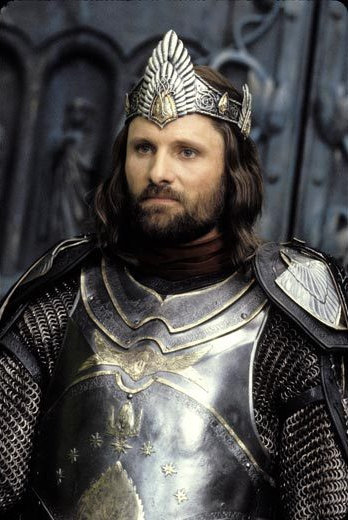
King Aragorn (Viggo Mortensen)
Unfortunately, the days of true monarchs are gone. There is no way to compare an 'office ruler' to a sovereign who would take his horse and sword, charge the army and go into battle. Those sovereigns of the past were ready to die - and for a noble cause. To this aspect let us add the values they used to embody and profess. Kings, unlike state leaders nowadays, based their rule on certain ethics. Unless we are talking about tyrants, they were quite charming, captivating, awe-inspiring, courageous.

What do we have left today?
The history passionates may not feel completely deserted, because they can easily take refuge into history books and contemplate what once was. Nevertheless, this could hardly be a universal solution to our hunger for kingly values. Luckily, for the rest of us there are the books - the fiction ones especially. Also, there are the movies. It seems that, wherever we look, the best stories are those involving royalty and perhaps some war, too. 

Kings in movies and the people's reaction nowadays
Richard Armitage as Thorin Oakenshield in The Hobbit
Prince/crownless king Thorin Oakenshield (Richard Armitage)
Without a doubt, they absolutely love them, plain to see. Fantasy writer J.R.R. Tolkien and now director Peter Jackson have been milking this frantically. They created fascinating monarch figures, addictive even. (The Game of Thrones is not far from that, either).

Pop culture has been invaded by long-haired, more or less bearded, armed kings and princes - characters the world once thought to be just relics, incompatible with our times. For the disbelievers, there is always available evidence online of the legacy of Aragorn Elessar, to give the most prominent example. More recently, another warrior king claimed the spotlight. As of December 2012, when the first film of The Hobbit trilogy got on screen, Thorin Oakenshield quickly gathered an army of thousands of followers. The character, although invested with traits that weren't supposed to attract sympathy, surpassed all expectations and became a detached favorite of the crowds. Handsome, incredibly daring and courageous, fighting for honor, loyal, caring for his kin, proud, determined, rugged, aware, this noble hero enraptured viewers in a way rarely seen before.

Kings with all their might, even with their burdens, turmoil and failures, embody everything that many of us find fascinating. Some may have forgotten, some may be denying it, but there is a longing for all of their kingly traits, for their rare qualities. Those like me are fully confessing it: we feel that the world has never been in a greater need of righteous kings than it is now. 

10 May 2013

Posted by Anna Notaras | File under : ,

Building yourself an undeserved brand.
Unless you are a professional of some kind, there is no reason to get yourself a fancy title, a logo, a watermark with your name and so on. Also, do not present yourself writing in third person. Do not mention it is your "official Facebook profile" unless you really are a celebrity.Let the fame come first, and then tune your profile to match it if so you wish. Don't brand yourself just for the sake of it.

Arguing over tastes and opinions.
"Welcome to the Internet, where opinions are facts", a good observer said once.Sarcasm, I hope you detected it. Sadly, most users are acting as if all opinions - their especially - are undeniable facts. Getting all inflamed because someone praises a book you didn't like, is a fan of an actor you hate or has different beliefs than you is a sign of severe immaturity. Unless they try to push their choices on you, there is no reason to get alarmed, really. You wouldn't want to be jumped at for choices that aren't harmful.

Starting an argument with someone, then unfriending/blocking them yourself.
Nothing spells 'psycho' better than behaving like this. If you provoke someone, overly criticise, insult, condemn or troll in an open manner for what they have posted, and then you are the one to act hurt and upset, you shouldn't be on Facebook at all. It's up to the other person whether you stay in the list or not.

Over-bragging.
Alright, Facebook is indeed a place where everyone want to be seen as better than they really are, where they show to their ex their so-much-better actual partner, where they post holiday plans and pictures, show how many parties they attend and so on. Therefore, bragging is normal here, but when you overdo it you sent a terrible message out there. No one will be impressed that you ate 3 types of expensive French cheese for dinner, that you just went shopping where none in your friends list can afford, or that you look astonishing in bikini. When too much is too much, you simply pass as desperate to prove your worth. The breaking news is that such despair will never work in your favor, to state the obvious.

Being hostile to nerds.
It's OK to have a passion and it's OK to not take Facebook so seriously. Let those nerds be, let them post and share about The Lord of the Rings, Sherlock or Star Trek - at least they have a passion and they're having fun. If it's too much for you, filter out their updates and remember that we are all here to post whatever we like. Maybe your friends are also sick of your objectifying pics of naked women. There is really no reason to turn hostile or to ridicule those people. After all, you may be that annoying user who plays FarmVille or other extremely intelligent form of entertaining, pestering others with game requests.

Being the rebel.
Maybe some find it cool in school, but when you keep on being the rebel just for the sake of it and you overdo it, there is nothing good to believe about you. It spells no intelligence whatsoever to post only 'scandalous' words or photos, to talk dirty, to mention all the time how 'naughty' you are, to brag about how you don't conform to social or moral norms. It is boring and ridiculous.

Getting inflamed at grammar Nazis.
Grammar Nazis spotted a mistake and they want people to respect their language and to write in an acceptable manner. Point is, you wrote something wrong. Deal with it. It makes no sense to start a flame war because someone corrected you.

Too many post.
Some users out there make at least 20 posts a day, which is beyond more than we can take. Even though your posts are cute, interesting or you really want to share them so badly because they are pure treasures, temper yourself and understand that everyone eventually gets tired of having their newsfeed invaded by a single user. This forces us to unsubscribe and thus your really important updates may be seen by no eyes in the end.

Being there all the time.
Whenever I go to my account, I see the exact same people posting, liking or commenting right at the time. No matter the time of the day.When I check friend's updates, the same people have already liked or commented. Everything. They leave their prints on everything there is. Stop it and get a life. If you think that being there all the time is going to improve your life, stop now. You're not social, you're creepy.

And ultimately... liking your own posts.
It is beyond obvious to anyone that the update/news/photo/video/status you posted is relevant, important, funny or likeable to you. Therefore, what is the point of giving it a 'like' yourself?...

8 May 2013

Posted by Anna Notaras |
- Part of the analytical journey "Film Thorin vs. Book Thorin" -
"At the University, we used to debate whether a literary work can be greater in the end than its author has intended. An author may unconsciously invest his work with underlying meanings and traits. While he is unaware, others may catch on those."
Richard Armitage as Thorin Oakenshield in The Hobbit
The human mind works with archetypes, and this is what we usually deal with in Literature and Film. Therefore I would appreciate it if certain types of readers don't get inflamed and don't consider this as religious propaganda, indoctrination and so on, because it is a simple talk of archetypes, their meanings and how we have these impregnating our art.
Undeniably, Tolkien was a devout Christian of Catholic denomination.
No matter what your beliefs are, it is impossible to write something that is not in tune with them, especially when it's such a vast work of art. Considering this, one is often tempted to find the places where the author's beliefs are getting through in a more obvious way - be it planned or not. In the light of such fact, we can venture to explore Tolkien's books and analyze their nature. With Thorin Oakenshield, things have taken an interesting turn, especially with the cinematic installment.

A New Archetype: Thorin as a "Warrior Christ"

The term of "warrior Christ" came to me as I was counting all the striking similarities, as well as the obvious contrasts. Tolkien couldn't have had the intention of making such a portrayal, because the ending and the moral of the story stand in opposition to this idea. But to me, the King Under the Mountain is noble, loving, kind, loyal and determined, he has a certain purity of the soul, in spite of his anger, hurt and bitter destiny. I had to find a term to describe his uniqueness. Below is a list of the coincidences, followed by insights of how the character would create a new and captivating archetype.

    The Coincidences:
  • ascetic, not married
  • has an exceptional following (not only in the company he gathers for the quest, but also outside the work of art itself, in the fandom)
  • been a simple worker for many years of his life (blacksmith)
  • capable of immense love - not only for his kin, but even for the hobbit he much despises.
  • noble origin
  • has 12 immediate followers
  • these followers are not of the brightest (also the disciples were seen as imperfect many times, but it was the "willing heart" that got them there)
  • it's himself to say - not Balin - "for when I called, they answered" (Balin is the disheartened one, but Thorin has the hope, he sees the good in them).
  • set to reclaim his father's lost kingdom
  • dies because of his mission, but is sure of the afterlife and looks forward to going to the halls of his ancestors.

As a close observer of The Hobbit phenomenon, what I was amazed by was the incredible following that Thorin would get with the first film. Although his position was meant to have common points with that of an antagonist (which is anyway a gross exaggeration to me), he got way ahead of Bilbo - he practically stole the show. He would inspire genuine appreciation and love, and lead fans to the point of fanaticism. If Thorin were a real leader existing on our planet, there would have been great unrest within the society. I can safely assume that his followers would be quickly seen as a fierce, exhilarated and uncompromising sect that would have in sight nothing else but their leader and his goal. My claims may appear as exaggerations, but the time spent at the core of the fandom and the endless conversations I had with various fans have shown me so. Thorin's charisma as a leader and a hero are undeniable. Indeed it would be very interesting, to say the least, to have a real, living Thorin.


Tolkien hasn't conceived Thorin as a christic figure, by no means. But then why....

Well, he obviously hasn't, but then shall we just ditch all those coincidences? I believe the one we should look at from now on is Peter Jackson. He was the one to invest so many of such elements, that is impossible not to think of it. A warrior Christ I'd call him, why not? Humans work with archetypes, and this is what we usually deal with in Literature and Film. Therefore I would appreciate it if certain types of readers don't get inflamed and consider this as religious propaganda, indoctrination and so on, because it is a simple talk of archetypes, their meanings and how we have these impregnating our art.

Allegory? I wouldn't go that way. There is something however, and this exquisite portrayal made me call Thorin Oakenshield the warrior version of Jesus. Perhaps he isn't supposed to convey more than Tolkien initially intended. Therefore he is just that: a unique kind of character, which everyone is free to interpret as desired. This is my interpretation, one still burdened by many question marks.

A book can be more than what its author has intended...

As seen in the film, Jackson & Co. have invested in Thorin much more. Thorin has lines that don't appear in the book (in the Bag End scenes especially), but which deepen his character and are very relevant. Most of the coincidences posted above are rather emphasized in the film. Could Peter Jackson have wanted to take this character to a different level? Could he have seen certain potential in him that Tolkien hadn't seen? We have a greater King of the Dwarves thanks to him. At the University, we used to debate whether a literary work can be greater in the end than its author has intended. An author may unconsciously invest his work with underlying meanings and traits. While he is unaware, others may catch on those. It is what I was trained to recognize when dealing with a work of art. I am sure this can be applied to many cases.

Possible Reasons

I am purely speculating here, but Sir Peter Jackson could have invested the King with these traits for their appeal to the masses. The great majority of the viewers would pick on these clues (subconsciously or not) because they are familiar to them. It also makes the story more touching. There will be drama, beware.